Concrete vs Fibreglass Pool Design in Sydney
Concrete Pool vs Fibreglass Pool Design in Sydney
Which is right for your backyard?
If you're after some swimming pool design advice in Sydney and you're planning a new pool, the first real fork in the road is not shape or colour, but construction type. Concrete and fibreglass pools solve the same problem in very different ways, and that choice dictates just about everything downstream — your budget, your build timeline, how the pool looks against your landscaping, and how much weekend time you'll spend maintaining it for the next few decades.
Here, we'll take you through the actual process of building each type of pool, what that means for design freedom on a typical Sydney block, and how the two options compare on price, installation time and ongoing maintenance — so you can walk into a quote conversation already knowing what questions to ask.
How concrete and fibreglass pools are actually built
Concrete
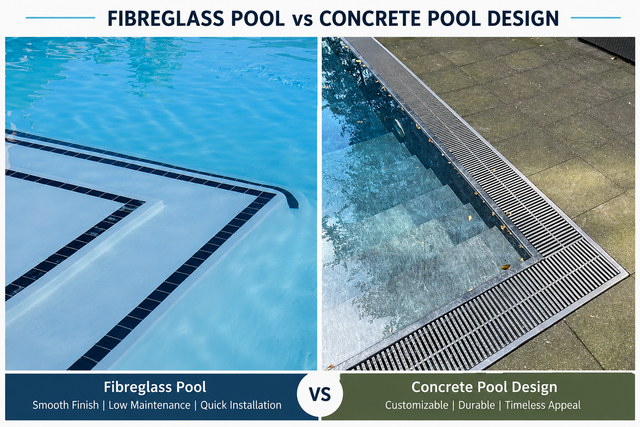
Built entirely on-site. A crew excavates the hole, installs steel reinforcement, sprays or pours the shell, then finishes the interior with a render, pebble, or tiled surface. Every part of the process happens in your backyard — which is exactly why concrete pools can be shaped, sized, and detailed almost without limit.
Fibreglass
Manufactured off-site as a single moulded shell, then trucked to your property and lowered into an excavated hole with a crane in one piece. The shell arrives with its surface already finished — a smooth, non-porous gel coat — so there's no separate rendering or tiling stage before it's ready to fill.
That single difference in construction method explains almost every trade-off between the two.
Design freedom: where each pool type wins
Concrete pools
Because concrete is formed on-site, it's the clear winner for custom design. If you're working with:
- An irregular or narrow inner-city block
- A sloped site (common across the Sydney basin and North Shore)
- A design brief involving infinity edges, beach entries, swim-up bars, grottos, or a specific bespoke shape
- A desire to match the pool's coping and interior finish precisely to existing landscaping, tiles, or stone
Fibreglass pools
Many modern ranges are much larger, with integrated bench seating, tanning ledges and shallow splash zones, but you're still choosing from a selection of pre-designed models rather than creating one from scratch.
Fibreglass really shines on standard rectangular or lap-style blocks, and for families looking for proven, safety-tested features (rounded steps, shallow-end depth throughout) without the full customisation.
Installation timeline: a realistic comparison
This is often the most underestimated factor in swimming pool design in Sydney, especially for households trying to plan around a summer deadline.
If you're chasing a specific start-of-summer opening date, this timeline gap alone can be the deciding factor.

Maintenance: what ongoing ownership actually looks like
The smooth, non-porous gel coat on fibreglass resists the growth of algae, so you'll generally do less brushing, see more stable chemical levels, and pay lower ongoing chemical costs. A lot of Sydney owners say they clean fibreglass pools "little and often" rather than following the intensive brushing regime concrete surfaces require two to three times a week.
Porous, textured concrete finishes — particularly pebble or exposed-aggregate finishes — are more prone to algae and generally require more frequent brushing and chemical treatment. It also needs to be resurfaced every 7 to 15 years or so, a cost worth budgeting for over the life of the pool, though many owners see this as a chance to update the look of the pool.
Which pool type suits your Sydney block?
Concrete makes sense when
- Your site is irregular, sloped, or has restricted access
- You want a fully custom shape, infinity edge, or integrated spa
- Long-term resale value and a completely bespoke finish matter more than build speed
- You're comfortable with a longer build and higher upkeep for total design control
Fibreglass makes sense when
- Your block is fairly standard or rectangular
- You want the pool ready faster — ideal toward a summer deadline
- Low weekly maintenance is a priority
- Budget certainty matters, since shell cost is fixed upfront
Common mistakes to avoid
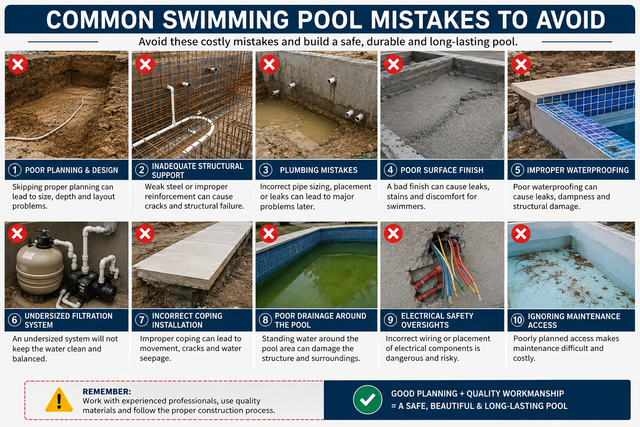
- Choosing purely on upfront price without factoring in resurfacing costs (concrete) or design limitations (fibreglass) over a 20–30 year ownership period.
- Underestimating access requirements — fibreglass shells need crane access, and narrow terrace blocks or tight side access can rule this out or add significant crane-hire cost.
- Skipping council and pool-fencing compliance costs in the initial budget — both pool types require compliant fencing under NSW regulations, typically $3,000–$10,000 extra.
- Not checking soil conditions early — Sydney's mix of sandstone, clay, and reactive soils can affect both excavation cost and which pool type is more practical on a given site.
- Assuming all fibreglass shells are equal — shell quality, warranty length, and gel coat technology vary significantly between manufacturers.
Final takeaway
There's no universally "better" option in the concrete vs fibreglass debate — only the better fit for your site, timeline, budget, and appetite for ongoing maintenance. If your Sydney block is unusual and you want complete design freedom, concrete earns its higher price and longer build time. If you want a proven, lower-maintenance pool installed in weeks rather than months, fibreglass is hard to beat.
Whichever direction you lean, get a site-specific quote before deciding — soil conditions, access, and council requirements can shift the real-world cost and timeline more than the pool type itself.
Get in touchFAQs
Is a concrete or fibreglass pool better for resale value in Sydney?+
Both add meaningful value — Sydney homes with a pool have reportedly gained $100,000–$200,000 in value. Concrete's custom design can appeal strongly to buyers on premium properties, while fibreglass's low-maintenance reputation appeals to family buyers.
How long does it take to build a concrete pool in Sydney?+
Most concrete pool builds take roughly three to five months from excavation to handover, depending on design complexity, weather, and site access.
How long does a fibreglass pool installation take?+
Once approvals and excavation are complete, the shell itself can be installed within days, with the full project — including plumbing, coping, and fencing — often finished within a few weeks.
Do fibreglass pools crack?+
Quality fibreglass shells are flexible and resistant to cracking under normal conditions, though poor installation or extreme ground movement can still cause issues — shell warranty and installer reputation matter here.
Which pool type needs less maintenance?+
Fibreglass generally needs less maintenance thanks to its smooth, algae-resistant gel coat. Concrete's more porous surface needs more frequent brushing and chemical balancing.
Can I get a custom shape with a fibreglass pool?+
Not truly custom — you choose from a manufacturer's range of pre-moulded shapes and sizes. If a fully bespoke shape is essential, concrete is the only option.
Do I need council approval for either pool type in Sydney?+
Yes — both concrete and fibreglass pools generally require council or private certifier approval, plus compliant safety fencing, regardless of construction type.


Comments
Post a Comment